


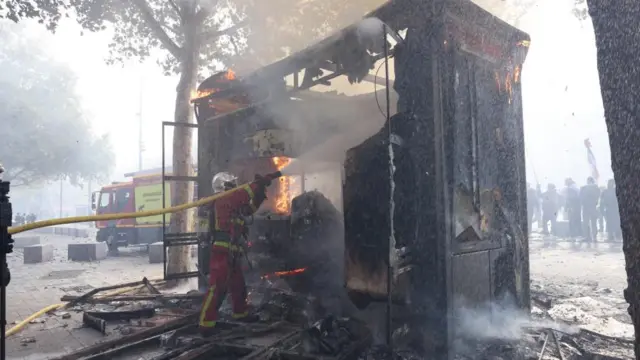
Riots, looting and arson in dozens of French cities on 17–18 October drew a quick reaction from Moscow. Kremlin spokesman Dmitry Peskov said Europe was facing a "major crisis" and described the disturbances as bordering on chaos.
The unrest grew out of protests that began in late September with student demands over study conditions. Trade unions and other groups soon joined, voicing anger over fuel prices, the cost of living and declining public services. Interior Minister Laurent Nuñez said he had expected about 200,000 people on the streets on 17 October, but at least 500,000 turned out. BBC Russian reported his assessment that the roughly 60,000 police mobilised nationwide were insufficient in some places to stop the rioting.
Estimates of the damage differ. The French government said at least 3,000 shops, pharmacies, restaurants and other businesses were damaged or looted. The French trade federation put the number of shops and retail outlets reporting damage at about 1,500. Detention figures also vary by outlet and cut-off time. Meduza reported more than 2,300 people detained over the 17–18 October unrest. BBC Russian reported more than 2,500 detentions since the riots began and about 1,000 police officers injured.
Nuñez acknowledged that police had "lost control" in some cities and offered to resign, but President Emmanuel Macron refused to accept his resignation. Prime Minister Sébastien Lecornu blamed ultra-left radicals and allowed mayors to impose partial curfews, including in parts of central Paris. He also announced emergency support for affected businesses, including fully state-funded partial unemployment and a dedicated support fund.
Peskov called the unrest an internal matter for the countries concerned. He dismissed accusations that Russia was involved in the protests as absurd.
Foreign Ministry spokeswoman Maria Zakharova accused Europe of applying "double standards" to protests. Separately, she accused France of diverting money from schools to Kyiv, using the labels "terrorist regime" and "neo-Nazi regime." The Moscow Times described the allegation of neo-Nazi control of Ukraine's leadership as a debunked Kremlin talking point.
Senator Alexei Pushkov called the scenes in France a "civil war" and blamed free migration. RT editor-in-chief Margarita Simonyan mocked France, Italy and Albania as supposedly flourishing countries. She also rejected suggestions that Russia had meddled in the protests.
Russia's main federal television channels gave the French story heavy coverage. BBC Russian examined 20 news bulletins on Russia's three main federal channels, from Sunday morning to Monday noon. It found they devoted more than an hour to the French unrest. A mass drone attack on St Petersburg received less than five minutes over the same period, with no standalone report.
According to BBC Russian, Rossiya 1 and Rossiya 24 aired a report claiming that protesters had "stormed" the Paris city hall shouting "Let's take the Bastille." The same coverage said the Fifth Republic had been "almost a month in flames." The Moscow Times reported that a correspondent on the Vesti programme blamed the unrest on migration.
In Limoges, the 19th-century city hall was set on fire on 17 October, according to franceinfo and TF1, and the building's bell tower collapsed. The local prefect called the fire a deliberate act by a "wild crowd." The city's mayor said police had lacked resources and that the state had failed. Lecornu has promised state help to rebuild the city hall.