


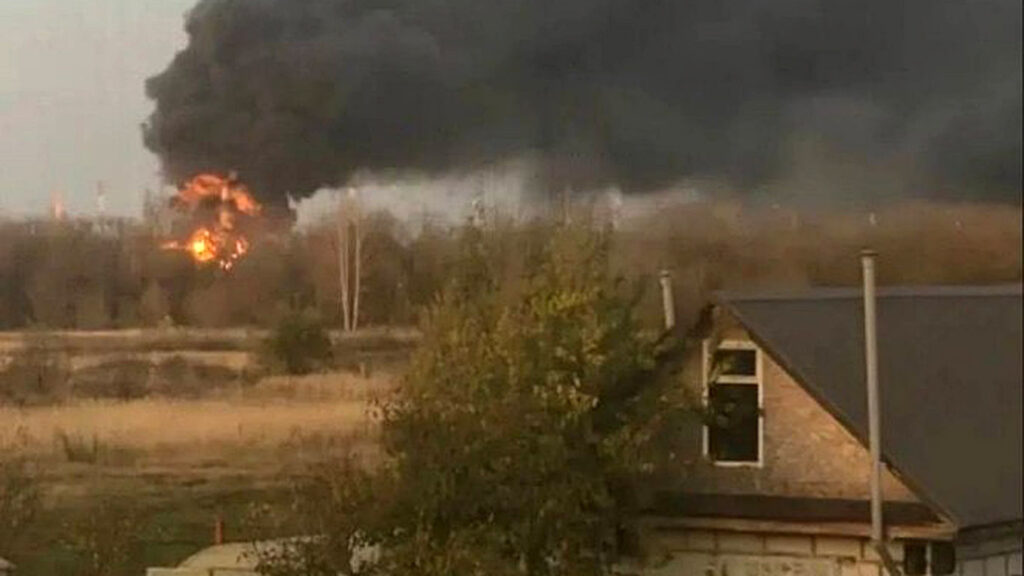
A drone attack set off a fire at an enterprise in the Michurinsky district of Russia's Tambov region on Oct. 20, Governor Yevgeny Pervyshov said. He did not name the facility and said no one was hurt. According to the governor, four Ukrainian drones were shot down over the region overnight and into the morning.
The district is home to Transneft's Nikolskoye linear production and dispatch station, a key transit node on the Druzhba oil pipeline, which supplies countries in Eastern and Central Europe. The station's pumping capacity is estimated at 300,000 metric tons per day.
The exiled outlet Astra said unofficial monitoring channels had reported a drone attack lasting several hours and air defense activity in the district overnight. Eyewitness video showed fires that were attributed to the strike. Astra said its open-source analysis of the footage suggested the blaze began at the Nikolskoye-1 station, probably at one of two production sites near the village of Novonikolskoye. The governor's statement did not identify the enterprise. Astra also reported that Ukrainian forces struck the Nikolskoye station at least twice in summer 2025.
The Tambov fire followed a St. Petersburg attack reported by Governor Alexander Beglov on Sunday. He said that attack killed one person and injured five. He said fires broke out at the city's oil terminal, an oil depot and industrial warehouses. E-commerce company Ozon said its St. Petersburg logistics hub was on fire. Internet company VK said drones had attacked its data center in the Leningrad region, though its services kept working as normal. Russia's Defense Ministry said air defenses downed 1,015 Ukrainian drones over Russian regions that night.
Days earlier, on Oct. 16, Khanty-Mansi Governor Ruslan Kukharuk said a drone attack set an industrial facility in the Surgut district on fire. He said the extent of the damage was still being assessed. Residents identified the site as the Surgut Condensate Stabilization Plant, according to the Ukrainian monitoring channel Supernova+, whose footage showed a large fire with thick black smoke. The Gazprom Pererabotka plant is described as Russia's largest facility for processing a mix of crude oil and gas condensate. It has a design capacity of 12 million metric tons per year.
Surgut lies about 2,500 kilometers from the Ukrainian border. The Khanty-Mansi region produces around 40% of Russia's oil. The Russian-language service of The Moscow Times called the attack the first strike on energy infrastructure in the region. Kukharuk had earlier warned of a drone threat, and aviation authorities restricted flights at the Surgut and Kogalym airports.
The Russian-language Moscow Times report said Ukraine resumed strikes on Russian energy facilities on Oct. 15 after a three-day break requested by U.S. President Donald Trump. The English-language report, published on Oct. 16, said Ukrainian forces struck the Ryazan refinery, Russia's third-largest, on Oct. 15. Ukrainian President Volodymyr Zelensky said Russia had not observed Trump's declared energy ceasefire and had killed more than 100 civilians in a week. He gave that as the reason the ban on refinery strikes was lifted.
Speaking at a business forum, President Vladimir Putin said Russia was actively retaliating for Ukrainian attacks on its data centers. "They took the first step and we began to answer," he said. He described the refinery strikes as "nothing particularly significant." The Moscow Times noted that his account conflicted with Defense Ministry reports that Russia had begun striking Ukrainian data centers the previous month. Putin also conceded that the security services had failed to anticipate attacks on logistics hubs such as Wildberries and Ozon.
The strikes have had effects at the pump. Crimea began rationing fuel in May after Ukrainian drones targeted military trucks and fuel tankers supplying the peninsula from the north. The shortages later spread to mainland Russia, and average gasoline prices nationwide have risen more than 21% since the start of the year. Sevastopol's Russian-appointed governor, Mikhail Razvozhayev, said purchase limits there were lifted this week because supply logistics had "practically stabilized." He added that some stations still ran out of certain fuel grades before restocking.