


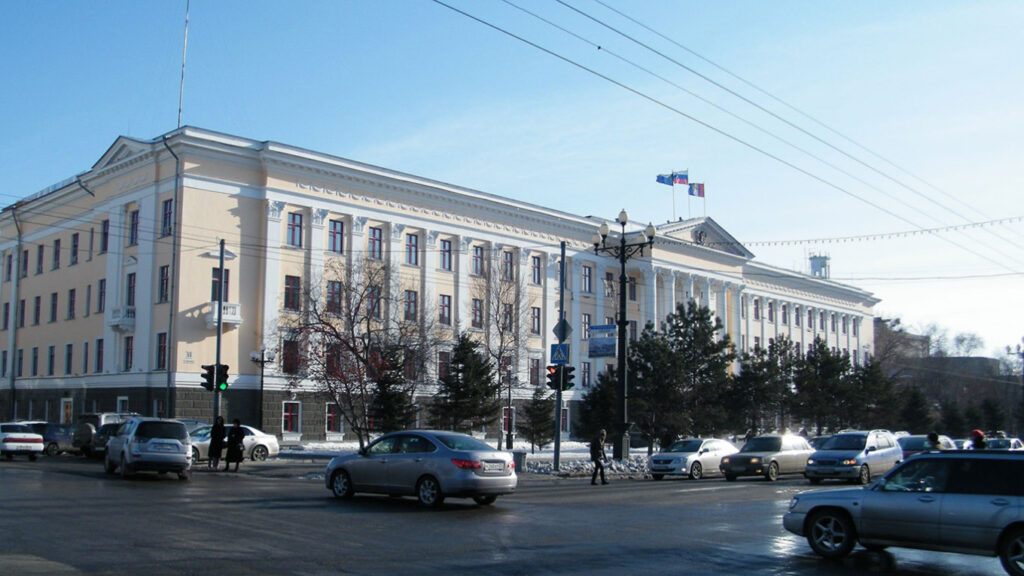
Lawmakers in the Far Eastern city of Khabarovsk have adopted a new city charter that ends direct mayoral elections. The regional legislature's press service, quoted by Interfax on Oct. 20, said city Duma deputies will now elect the head of the city from candidates put forward by the regional governor, in line with federal law. The charter replaces a document dating from 2004.
The Moscow Times, citing Interfax, described the new procedure as an appointment system controlled by the governor. The move came weeks after Mayor Sergei Kravchuk stepped down after winning a seat in the State Duma in the previous month's parliamentary elections.
Officials presented the change as a legal requirement. According to the regional legislature, it was dictated by federal legislation on a "unified system of public authority," and the draft had earlier gone through public hearings with residents. Nikolai Shevtsov, speaker of the regional Legislative Duma, said the regional parliament fully supports the decisions.
City Duma speaker Andrei Beloglazov drew a historical parallel. He said that exactly 123 years ago Khabarovsk lived under a similar charter, when elected councillors chose the head of the city. He added that the new document sets out budget relations in detail, covering revenue, spending and control of funds, as well as residents' participation in developing the regional capital. Deputies also approved oaths for the mayor and for deputies. The charter keeps public hearings and participatory budgeting, and it enshrines voluntary participation by residents in socially significant work.
Vedomosti had already reported earlier in October that after Kravchuk's move to the State Duma, only two heads of regional capitals elected by popular vote remained. They are Alexei Lemin in Abakan, in Khakassia, and Sergei Spitsyn in Anadyr, in Chukotka. Both won in 2024 as United Russia candidates. When their terms end, which is planned for 2029, no regional capital will have a mayor elected by residents, the paper said.
Vedomosti said the local self-government law requires mayors of regional capitals to be chosen by municipal councils from candidates presented by regional heads. Smaller municipalities can retain direct mayoral elections. The Moscow Times also noted that exception for smaller municipalities.
Vedomosti said a mass campaign against direct elections in regional capitals began in the late 2000s. Citing RBC, it said 66 regions had dropped such elections by the end of 2014. Direct elections were later abolished in Tomsk in 2022, Novosibirsk in 2023 and Ulan-Ude in 2024. Mayors have since been chosen under the new rule in cities including Kursk, Krasnoyarsk, Nizhny Novgorod and Yakutsk. In some cities, including Astrakhan and Yaroslavl, scrapping elections was accompanied by protests.
In a June 2025 opinion piece in The Moscow Times, Andras Toth-Czifra described officials including Vladimir Yakushev and Pskov Governor Mikhail Vedernikov as arguing that abolishing representative bodies and direct elections would make governance more efficient and save money. Toth-Czifra wrote that the wider overhaul provoked protests in regions such as Krasnoyarsk and the Altai republic, where authorities arrested activists. He wrote that the Krasnoyarsk bill, passed in about three weeks, would cut municipalities from 472 to 39. He also wrote that the city's mayor was arrested on corruption charges soon after the reform's adoption, effectively letting the governor pick his successor.
Ilya Grashchenkov, president of the Center for Regional Policy Development, said direct elections remain in demand in large cities and give mayors extra legitimacy. Consultant Yevgeny Minchenko called them optimal but said a return for regional capitals is highly unlikely soon. Sociologist Denis Volkov said most people would like to elect mayors but accept the current reality as a given. Vedomosti also recalled Kremlin spokesman Dmitry Peskov's comments in 2020 on the idea of returning direct mayoral elections. He pointed to past conflicts between governors and big-city mayors that he said left regions suffering for years.